Financial crime
AML alert triage
Alert storms on a single corridor, overwhelmingly false, ranked so the investigator’s hour goes to the case that deserves it.



Banking
Banking is 163 agents written for a retail and commercial bank. They work with the core banking system, the card management system and the loan origination system, and they leave credit, refunds and suspicious activity to the people accountable for them.
Built for
Built for a retail and commercial bank offering accounts, cards, personal and business loans, mortgages, payments, trade finance and wealth services through branches, relationship managers, mobile and internet banking. They serve retail customers, small businesses, corporate clients and wealth clients, and sell current and savings accounts, deposits, cards, personal loans, mortgages, SME and corporate lending, payments and cash management, trade finance, and investment products.
An expression of dissatisfaction is a complaint, and the regulator’s handling timeline starts at once.
Fee refunds, reversals and chargebacks follow the tariff, the refund policy and card-scheme time limits.
Business loans must meet the risk-adjusted return hurdle, or go to the pricing desk or Credit Committee.
Sanctions, AML/CFT and customer data secrecy apply to every case, with no tipping-off.
Inside the platform
The industry the agents know
Regulation
The agents keep to the rules your business already answers to. Each one becomes an approval step, a setting or a record your team can check.
These are examples from the markets Wersel works in, not a full list, and not legal advice. Your compliance team decides which rules apply to you, and sets the rules and limits the agents follow.

An expression of dissatisfaction is logged as a complaint at once, with its deadline, and a person approves the reply.
Suspicious activity goes to the MLRO with the evidence attached. Agents never tell a customer about a suspicion.
A possible match stops the case and goes to compliance. The agent does not clear it.
Customer data is read in your own systems when it is needed, under the access rules you set, and is not copied out.
Capital, liquidity and provision figures come from your risk systems, never from an estimate. Pricing outside the hurdle goes to the pricing desk or Credit Committee.
Scoring and pricing models come with a model card and an evaluation report, and a person signs off each decision they inform.
The platform runs in your tenancy under your keys, every run and change is on record, and exit terms are agreed before the first deployment.
Disputes are prepared within the scheme time limits, and card data stays in the card management system.
Your systems
Agents name no vendor. They connect to whichever system of each kind you already run, and read your data there.
Departments
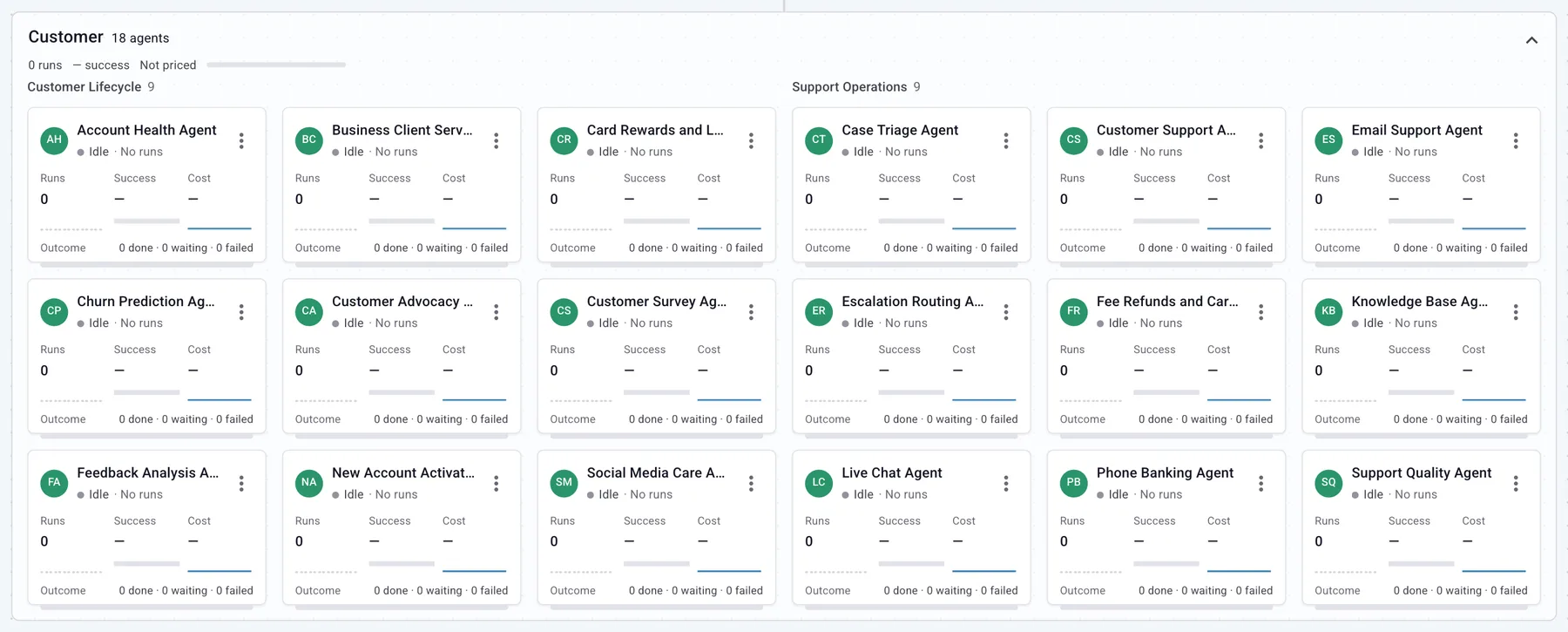
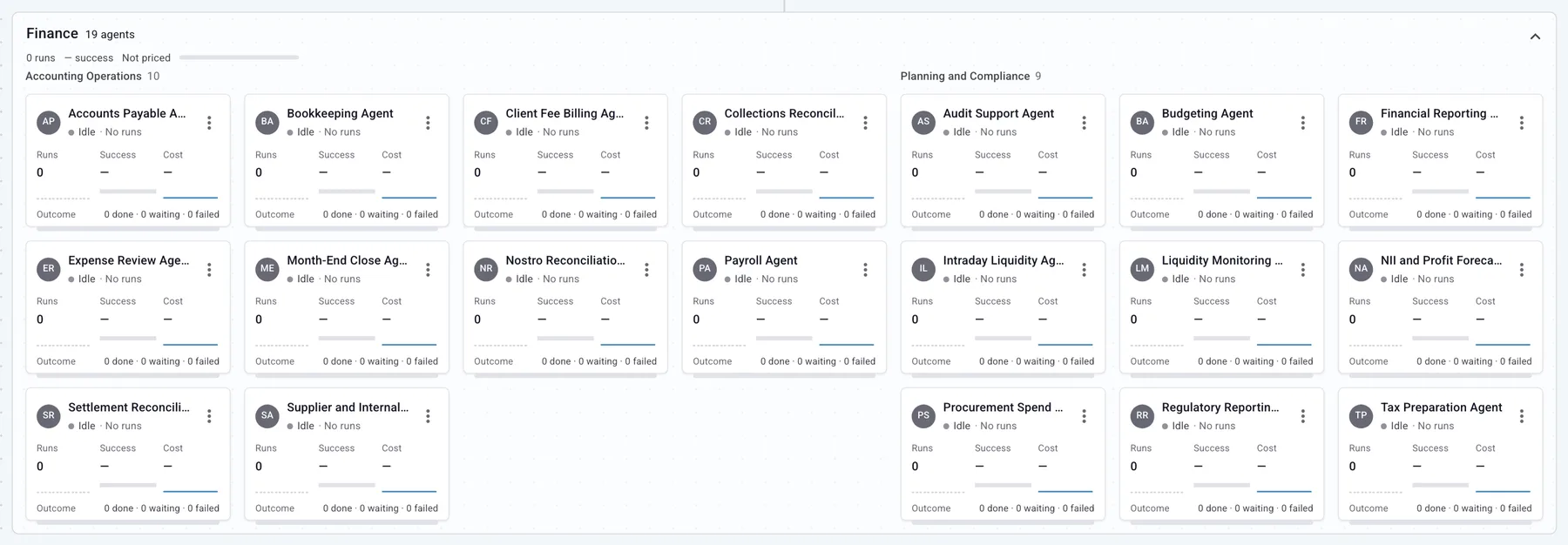
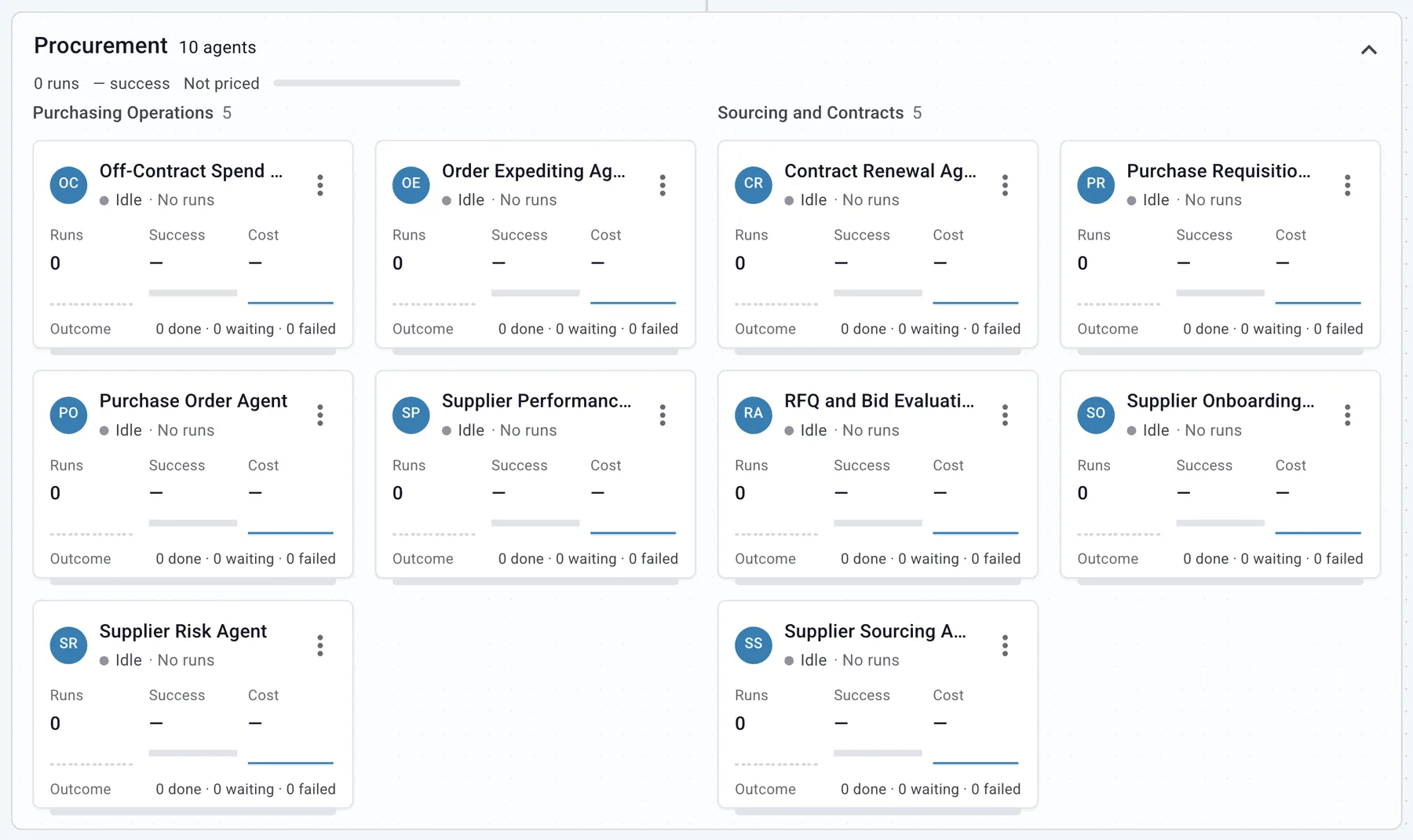
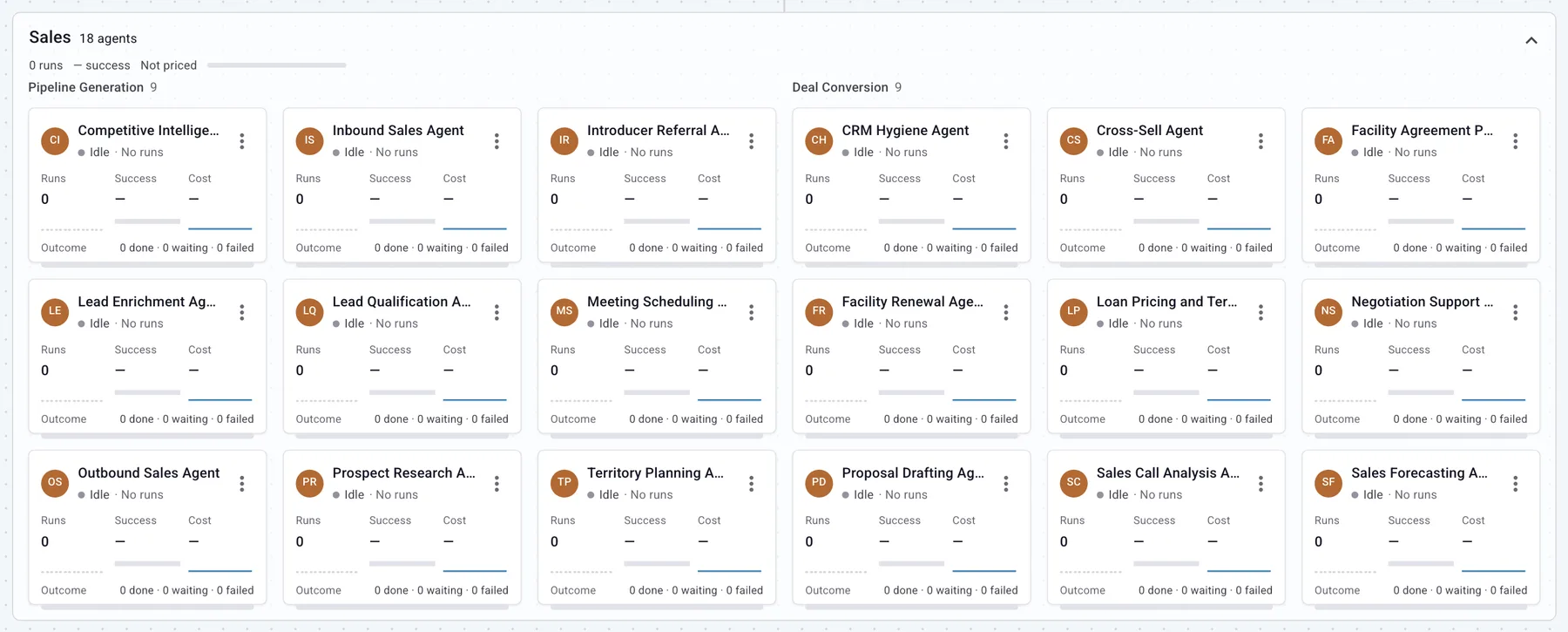
163 agents across 11 departments, each handing its work to the right Banking approver.
| Department | What it covers | Agents | Link |
|---|---|---|---|
| Content | video, writing, imagery and localisation | 12 | See agents → |
| Customer | support, service and retention | 18 | See agents → |
| Design | product, brand and experience design | 10 | See agents → |
| Engineering | building, running and securing the technology | 20 | See agents → |
| Finance | bookkeeping, payables, receivables, payroll, close and planning | 19 | See agents → |
| HR | hiring, onboarding, people operations and learning | 14 | See agents → |
| Management | events, programmes, operations and leadership support | 12 | See agents → |
| Marketing | advertising, campaigns, SEO, social and lifecycle marketing | 18 | See agents → |
| Procurement | requisitions, sourcing, suppliers and contracts | 10 | See agents → |
| Product | planning, research, analytics and launches | 12 | See agents → |
| Sales | pipeline, deals, proposals and account growth | 18 | See agents → |
AI agents
From a real run
This is what the approver sees: the agent’s finished work, waiting for a decision.
A frustrated, unverified retail customer reports a card payment declined abroad and asks for a written explanation and a refund of a foreign transaction fee of about 4.50 GBP. This is logged as a complaint, and a possible fraud block is referred to the fraud team. No records were available from the core banking system and the knowledge base returned nothing relevant, so the cause of the decline and the fee tariff are unconfirmed. If approved, the complaint is logged and acknowledged within 1 business day, the customer is asked to verify without sharing card secrets, and any refund above 0 USD is decided by you after the fee is confirmed against the verified account.
The approver can approve or edit and approve. Nothing is sent or changed until they do.
Use cases
Declined cards, missing transfers and fee queries answered from verified records, with complaints recognised at once.
Refunds, reversals and chargebacks checked against the tariff, the refund policy and card-scheme rules.
Facilities priced from risk grade, security and cost of funds, checked against the risk-adjusted return hurdle.
How the work flows
Core banking system
Card management system
Loan origination system
CRM
Decisions we model
Beside the agents, purpose-built models for fraud, AML, credit and treasury: deterministic where the decision has to be reproducible under challenge, language models where the problem is reading a document.
How we scope an outcome →Alert storms on a single corridor, overwhelmingly false, ranked so the investigator’s hour goes to the case that deserves it.
A new, mule-linked beneficiary and an amount far off the customer’s baseline, decided in the payment window, not afterwards.
Leverage above covenant for consecutive quarters, buried in a reporting pack nobody reads until it is too late.
Merchant evidence that contradicts the chargeback claim, across a backlog of hundreds of claims per analyst.
A nostro buffer projected to breach in the afternoon, forecast in the morning while there is still time to act.
A registry filing changes the ultimate beneficial owner, and the periodic review is eleven months away.
Connected and governed
Read in place, never copied: Core banking · Payment rails · Card processor · KYC & due diligence · Sanctions & PEP lists · Data warehouse · Credit bureau feeds · Treasury & ALM.
Tell us which service, lending or back-office work you want to improve. We’ll reply within one working day.