Cloud
Your cloud tenancy
In your account and region, under your keys.

Reference architecture
Everything runs inside your environment: your cloud tenancy, your data centre or air-gapped hardware. This page shows the layers, what each one does, and exactly what can cross the boundary.
Bring this page to your architecture review. We walk your team through it on your own estate before a pilot.
The layers
Requests start with your people, pass through the control plane and the gateway, and are answered from your own knowledge and records. Governance, observability and the audit trail run across every layer.
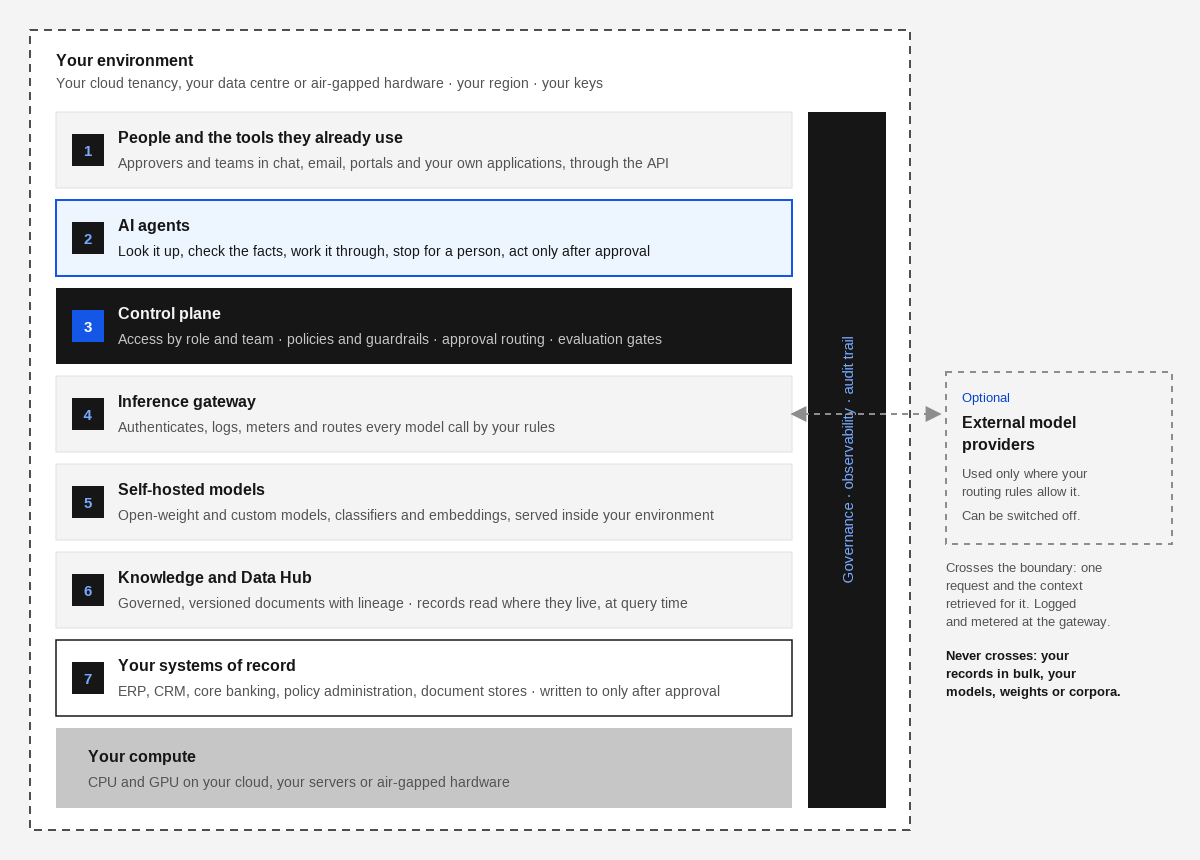
Approvers and teams work where they already do: chat, email, portals or your own applications through the API.
Each agent looks things up, checks the facts, works the case through and stops for a person when its rules say so.
Who can see and do what, by role and team; the policies and guardrails; approval routing; and the gates a model must pass before promotion.
Every model call is authenticated, logged, metered and routed by your rules, per project, per model and per team.
Open-weight and custom models, classifiers and embeddings served on your compute.
Governed, versioned documents with lineage back to the source, and records read where they live at query time.
ERP, CRM, core banking, policy administration and document stores. Agents write to them only after approval.
The boundary
Can cross, only if you allow it: a single model request and the context retrieved for it, sent through the gateway to an external model provider you have chosen. It is logged and metered like every other call, and you can switch external routing off entirely.
Never crosses: your records in bulk, your documents and corpora, models and weights built for you, decision history, approvals and the audit trail.
The full table is on the security page. To forward internally: the platform on one page (PDF) and security on one page (PDF).
Deployment
Every option runs the same platform with the same governance. The choice is usually made by residency, sovereignty and blast radius before the model is chosen.
In your account and region, under your keys.
Sensitive workloads and data stay on your servers; the rest runs in your cloud.
On your own hardware, behind your own firewall.
Self-hosted models only, for environments that demand it.
Connecting your systems
Which systems, which records, who can see them and how long anything is kept, agreed in writing with your security team.
Agents read the records they need at query time and prepare their work for a person. Nothing is written back.
Agents propose; your approvers approve, edit or send back. Each decision is recorded with its evidence.
Only the actions you approve, in the systems you choose, within the limits you set as settings.
No. The platform holds application state and metadata. Business records are read where they live, at query time.
Yes. Routing is set at the gateway by your rules, and every request can be kept on self-hosted models. Air-gapped deployments use self-hosted models only.
Through a REST API across the platform, Python and TypeScript SDKs, an OpenAI-compatible inference gateway, and MCP so models are reachable as tools.
They are yours and already in your environment. Which artefacts transfer, in what format, is agreed in writing before the first deployment.